
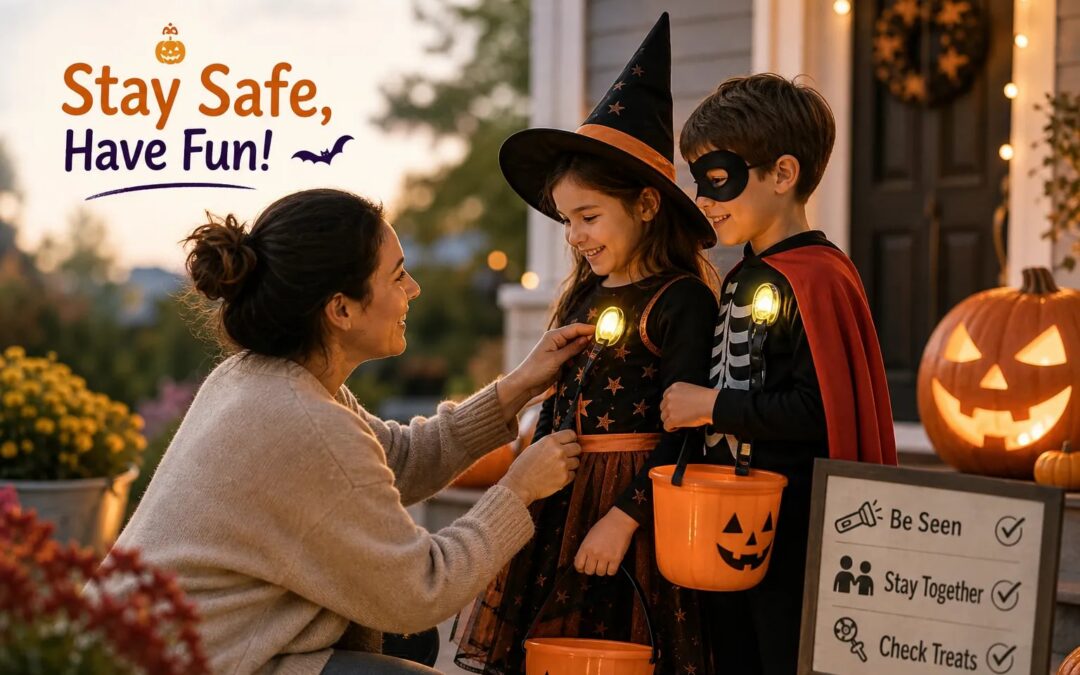
Before your family steps out the door tonight, run through these halloween safety tips across four areas: costume safety, pedestrian visibility, candy inspection, and allergy awareness. Together, they address many of the most common risks that send children to emergency departments on Halloween. According to MoneyGeek, 45 children were killed as pedestrians on Halloween between 2010 and 2024, making it the deadliest calendar date of the year for child pedestrians. This article walks through each safety area as a practical, physician-minded checklist that families in Plainfield, Indiana and across the country can run through before trick-or-treating begins.
Many of these risks can be reduced with simple, quick steps. Work through this checklist once, send your kids out prepared, and the night stays exactly what it should be: fun.
Key takeaways
- Pedestrian danger is real: 24 of 45 child pedestrian deaths on Halloween occurred between 6 p.m. and 9 p.m., the core trick-or-treating window. Traffic rules and reflective gear are non-negotiable.
- Costume fit matters most: Dragging hemlines, vision-blocking masks, and flammable synthetic fabric are the three hazards most likely to cause injury. Each has an immediate fix.
- Retroreflective tape outperforms glow sticks: Reflective material bounces vehicle headlights back toward drivers at much greater distances than glow products can manage.
- Inspect all candy at home: Wait until you’re back inside before eating anything. Discard any item that is unwrapped, has damaged packaging, or smells unusual.
- Allergy families need a plan: Read every label, keep safe and unsafe treats completely separate, and ensure the supervising adult can use an epinephrine auto-injector if one is prescribed.
- Know when to call a physician: Hives, swelling, or breathing changes after eating a treat, or a wound that won’t stop bleeding, warrants a call to someone who knows your child, not a generic hotline.
What makes Halloween the most dangerous night for child pedestrians?
The pedestrian risk on Halloween is larger than most parents realize, and the numbers back that up clearly. According to MoneyGeek, 45 children died as pedestrians on Halloween from 2010 through 2024, nearly twice the 23 deaths recorded on the next-highest date. Twenty-four of those deaths occurred between 6 p.m. and 9 p.m., precisely when most families are out. That peak window is not a coincidence. Darkness falls, street traffic is still active, and drivers aren’t expecting hundreds of children moving between parked cars in residential neighborhoods.
The risk is not about strangers. It’s about cars, darkness, and distracted drivers who aren’t anticipating foot traffic at that volume. Because the risk is predictable, it’s preventable with the right rules in place before anyone leaves the house.
Children under 12 should be accompanied by an adult on a planned, familiar route. Older children going in groups need a charged phone, a specific return time, and a route reviewed with a parent beforehand. These aren’t suggestions open to negotiation; they’re the baseline that pediatric guidance consistently recommends.
The behavioral rules that directly cut pedestrian risk are straightforward: use sidewalks and marked crosswalks, cross only at corners, look in all directions including for turning vehicles, visit only homes with porch lights on, and never cut between parked cars. Each of these rules addresses a specific, documented cause of Halloween pedestrian incidents.
Not every neighborhood has sidewalks, and that’s a common reality in many suburban and rural areas. When sidewalks aren’t available, walk single-file facing traffic on the left side of the road, use the widest and best-lit path available, and keep the group tightly together. This is exactly where the visibility gear covered in the next section becomes essential rather than optional.
Halloween safety tips for costumes and fire risk
Fit and vision
Three hazards hide in most costumes, and all three are fixable in under five minutes. The first is tripping from dragging hemlines, oversized capes, or floppy footwear. Hem or pin anything that touches the ground, and choose sturdy, well-fitting shoes. The second is impaired vision from ill-fitting masks. Replace full masks with non-toxic face paint or a hat whenever possible; if a mask is necessary, it must have large unobstructed eye openings, fit securely, and allow easy breathing.
Flammability
The third hazard is flammability from synthetic or untreated fabric. Choose costumes, wigs, and accessories labeled “flame resistant,” and keep children away from candles, fireplaces, and heat sources entirely.
“Flame resistant” does not mean fireproof, and that distinction matters. According to the CPSC, these materials resist catching fire and slow the burn, but they will still ignite with sustained exposure to an open flame. The practical response is to treat every costume as flammable regardless of its label. Use battery-operated LED lights in jack-o’-lanterns instead of candles, check electrical decorations for damaged or frayed cords, and teach children the stop, drop, and roll response before they go out.
The five-minute walkthrough
Before leaving the house, run a five-minute physical walkthrough with your child in the complete costume. Have them walk, turn, sit, climb a single step, look left and right, and take a few full breaths. Check that shoes don’t slip, that hats and hoods can’t slide over the eyes, and that any prop is short, flexible, and not sharp. If anything fails the test, fix it before going out. This quick check takes far less time than a trip to urgent care.
Halloween safety tips: Visibility gear that genuinely works after dark
Glow sticks are popular, and they’re not useless, but relying on them alone gives families a false sense of security. According to NHTSA, retroreflective tape and safety vests are the highest-priority visibility tools because they return vehicle headlights directly back toward the driver. That matters at driving distances where a glow stick’s light source simply isn’t strong enough to register in time for a driver to react.
The recommended layered approach works like this:
- Apply retroreflective strips to the front, back, sides, wrists, ankles, and backpack. Moving body parts like wrists and ankles are especially effective because the motion catches a driver’s eye.
- Clip a small LED light to the jacket, bag, or shoe. Active lights fill in visibility between streetlights and when headlights aren’t aimed directly at the child.
- Give the child a flashlight or light-up wand for path lighting. This helps them navigate uneven ground and makes their location easier to read from a distance.
- Add a glow bracelet or stick as a secondary supplement, not the primary protection.
Bright clothing is useful at dusk but is not a substitute for retroreflective material at night. For children under three, skip glow sticks and bracelets entirely; the small connectors can break and present a choking hazard. Use securely attached reflective materials instead.
How to handle the candy haul once you’re home
The rule is simple: nothing gets eaten until you’re back inside and an adult has sorted through it. Under supervision, go through every item and discard anything that is unwrapped, appears homemade from an unknown source, or has packaging that looks damaged.
Specifically, look for pinholes, opened or loose seams, discoloration, unusual odor, or mismatched labeling. Tampering is statistically rare, but a suspicious item should always be thrown away. If there’s a credible concern about a specific piece, keep the packaging intact and contact local law enforcement.
For allergy families, label reading isn’t optional. Read every ingredient list on every item, and don’t rely on your child recognizing a familiar wrapper, since packaging can change. Keep allergen-containing treats completely separate from safe alternatives, and discourage any swapping or sharing. If your child carries a prescribed epinephrine auto-injector, it goes with them during trick-or-treating, and the supervising adult needs to know how to use it and what a severe reaction looks like.
The Teal Pumpkin Project, a FARE initiative, gives allergy families a practical option on their route. Homes that display a teal pumpkin offer non-food treats such as stickers, glow bracelets, or temporary tattoos, alongside or instead of candy. Participating is as simple as setting out a separate bowl of non-food items and displaying a teal pumpkin or printable sign.
For babies and toddlers, remove hard candy, gum, whole nuts, chewy or sticky candy, small novelty items, and candy wrappers before the treat bag is anywhere near them. Always have children sit while eating rather than eating while walking, especially young ones.
What to do when a Halloween mishap becomes a real health concern
Most Halloween nights go smoothly. The situations most likely to need a physician’s attention fall into three categories: a suspected allergic reaction after eating a treat, a cut or wound that won’t stop bleeding or involves the eyes, and significant anxiety or emotional distress in a child who found the night overwhelming. Knowing this ahead of time means you’re not searching for options at 9 p.m. when you need an answer quickly.
For allergic reactions specifically, mild symptoms are typically limited to one body system: itchy mouth, a few hives, or mild skin redness. Severe reactions involve multiple systems and require immediate action: trouble breathing, swelling of the tongue or throat, repeated vomiting paired with hives, sudden weakness or confusion, or a pale or bluish appearance. If prescribed epinephrine is available, give it immediately for suspected anaphylaxis and call emergency services without waiting to see if symptoms worsen.
This is where having a dedicated family physician changes the experience. At Midwest Mind & Medicine in Plainfield, Indiana, members reach their physician directly through a secure patient portal.
Your Halloween safety checklist, in brief
These halloween safety tips cover four core areas: pedestrian safety with reflective gear and clear traffic rules, costume checks for fit and flammability, layered visibility before dark, and careful candy inspection at home. Work through each one before the first house, and you’ve done the most important work of the night.
Halloween safety isn’t about fear. It’s about giving children the preparation they need so the night stays exactly what it should be. The risks are real, they’re documented, and they’re preventable with the steps outlined here. That’s a good outcome for everyone.
Having a trusted primary care physician year-round is one of the most practical health decisions a family can make, and it matters most when something goes unexpectedly wrong. If your family is in the Plainfield area and you’ve been thinking about what relationship-based, whole-person care actually looks like in practice, our team at Midwest Mind & Medicine welcomes families looking for that kind of care. Reach out to learn more about membership and what it includes.
Frequently Asked Questions
What should the supervising adult know about using an epinephrine auto-injector?
The supervising adult should be able to recognize severe allergic reactions and use the epinephrine auto-injector immediately if one is prescribed. We advise giving epinephrine for signs of anaphylaxis, trouble breathing, throat swelling, repeated vomiting with hives, or sudden weakness, and calling emergency services right away after administration.
What should the supervising adult bring with them on trick-or-treating night?
Bring any prescribed epinephrine auto-injector and the knowledge to use it if one is prescribed, and ensure older children have a charged phone and a reviewed return time. Carrying those items and knowing how to act addresses the key risks of allergic reactions and keeps communication open if something goes wrong.
How do we check a costume for fire risk quickly and effectively?
Choose flame-resistant materials, treat every costume as flammable, and keep children away from open flames while using battery-operated LED lights for jack-o’-lanterns. Also check electrical decorations for damaged cords and teach children the stop, drop, and roll response before going out.
Why is retroreflective tape recommended over glow sticks as primary visibility gear at night?
Retroreflective tape returns vehicle headlights back toward drivers at much greater distances than glow products can manage, making it more effective for driver detection. Use retroreflective strips on multiple body locations, add a small LED for active light, and keep glow sticks only as a supplemental item.
When should we call our physician versus emergency services after a Halloween mishap?
Call emergency services immediately and use prescribed epinephrine for signs of severe anaphylaxis like trouble breathing, throat swelling, repeated vomiting with hives, sudden weakness or confusion, or a pale or bluish appearance. For concerns such as hives, localized swelling, breathing changes after eating a treat, or a wound that won’t stop bleeding, call a physician who knows your child rather than a generic hotline.